Readers’ letters on Labor’s breach of trust, small-business struggles, the budget’s tax changes and a return to boring breakfasts.
Either Albanese or Chalmers is lying
Treasurer Jim Chalmers now says the “fear of a scare campaign was why the government did not take the measures to the election” (“Friendless budget needs explanation, not condescension”). But the prime minister has repeatedly said since budget night, “I/we did not lie before the election. We have changed our mind.”
Leave aside for now how quickly they have appeared to have changed their minds, and on what evidence. Only one of them can be right. So which of them is lying now?
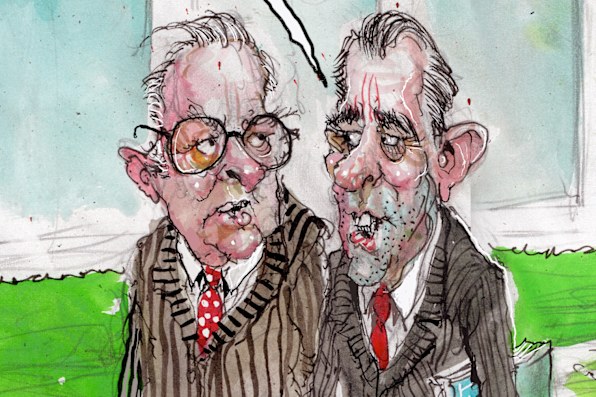
Before the election, both Anthony Albanese and Jim Chalmers repeatedly ruled out changing negative gearing and the capital gains tax discount. David Rowe
It sounds very much like the government had absolutely decided on these measures before the election. But it correctly (and cynically) decided that it would be poison to take these to the election campaign, when the broad and sound criticism that has now emerged would have been given an even louder voice.
I wonder what the “principled” teals are going to say about this huge breach of trust with the electorate, which seems to go against everything they espouse. They have been remarkably quiet so far.
Greg Howe, Toorak Gardens, SA
Budget offers peanuts to small businesses
The federal government announced $2 billion in small business support in this year’s budget. For those of us actually running one, that number feels like fiction.
I operate a wellness studio in Australia. In the past 12 months, my landlord has increased our rent, raised our bond, and passed on higher insurance and land tax costs. The minimum wage is up, and superannuation has been raised. Inflation is embedded in every supplier invoice I receive.
And yet, I cannot pass these costs on. My customers are under the same pressure that I face. They are watching every dollar. If I raise prices, they stop coming. It’s that simple and that brutal.
The budget offered eligible small businesses $150 in energy relief and a mental health helpline. I don’t need a helpline. I need meaningful land tax reform, a commercial rent relief framework, and genuine superannuation support for small employers that goes beyond a write-off that barely covers the cost of a second-hand coffee machine. Don’t get me started on BAS!
Small businesses employ nearly half of Australia’s private sector workforce. We are not a rounding error. We are the economy. Yet, we’re totally and utterly overlooked. Furthermore, we’re constantly disadvantaged and, pound for pound, have to overpay just to keep the lights on compared with big tech companies and corporations.
It is time the budget reflected that.
Neil O’Sullivan, founder, Nimbus Co
Easy for millionaires to preach about CGT
Daniel Petre is tired of rich people complaining about taxes (“Investor says he is sick of rich people complaining about tax”). It’s not about the rich, and his comments are so incredibly patronising and offensive to the vast majority who will be hurt by the new measures.
Mr Petre is among the uber-wealthy who have benefited from the current regime and made their millions, but he would deny the rest of us the opportunity. Hypocrisy.
Chris Forrest, Naremburn, NSW
Monster budget will consume the government
I am 81 years old and have been investing since my 20s. In that time, I have never experienced a budget as negative as this one.
Investors hate uncertainty, which in turn kills investment. The budget imposes great uncertainty and sovereign risk, as the government cannot be trusted to keep its word.
Moreover, there are no winners in the budget – the young, the old and those in between have been disadvantaged. Congratulations, Anthony Albanese and Jim Chalmers; you have created a Frankenstein that will consume investors, and eventually, the Labor government too.
Ron Fox, Maroubra, NSW
Tax on productive assets is anti-aspirational
We are recently married, 32 years old, and renting in Sydney. My wife works full-time, and I was a lawyer who has been successfully investing in companies and ETFs for more than a decade to fund my own business.
I do not want to purchase an investment property – first, because successful capitalism invests in productive assets or new ventures, and second, the attitude of housing as the only valid investment is how Australia got here in the first place.
I voted for Labor believing it would tackle the exorbitant housing prices caused by tax concessions. I never expected it to also tax the aspirational tools people have increasingly tapped to keep up or get ahead of housing.
The younger generations were condescendingly told, “Stop buying avocado toast and save”, and we did. Over the past six years, the nation’s ETF market has grown 400 per cent, in part driven by younger Australians locked out of housing and unable to start businesses of their own because of our over-regulated and anaemic start-up culture.
I’ve been a strong advocate for my friends not to look down on renting, to invest, and I was successful in getting ahead of the curve, where we now have options to buy a home or start a business. But we, and future Australians, would be better off owning unproductive and negatively geared investment properties.
There is no justification to tax “investment” properties and productive assets in the same way.
Alexander Cooper, McMahons Point, NSW
Trust changes ignore real-world asset protection
A principal objective of testators in creating a discretionary testamentary trust in their will is to protect their children and grandchildren from creditors, and aggrieved partners and spouses of these beneficiaries (“Grieving families in trust limbo as Labor denies ‘death tax’”)
A fixed testamentary trust where the children and grandchildren are defined as beneficiaries in fixed proportions exposes these beneficiaries and their interest in the fixed trust to the claims of the child or grandchild’s creditors, and to be pooled in the assets of a matrimonial dispute.
A fixed trust also does not provide flexibility for the differing circumstances and financial needs of the beneficiaries over the term of the trust.
The amendments proposed to discretionary beneficiary trusts do not give any thought to commercial issues in protecting family assets in the real world.
D. Lurie, East Melbourne, Vic
Finance in a financial publication? Really?
I like to start each day reading The Australian Financial Review while having my breakfast. In recent times, I have enjoyed many a thought-provoking article on important topics such as:
- The Waislitz-Behbahani shenanigans;
- Poor Brooklyn Beckham’s relationship with his parents;
- The disagreement between Blake Lively and Justin Baldoni; and, of course,
- The intimate details of Richard White’s private life.
Over the past few days, however, I have seen a stream of dreary articles about interest rates, the budget and the state of the economy.
This morning, as I listlessly lifted a large ladle of muesli to my lips, I couldn’t help thinking:
- “Why don’t you stick to your knitting?”
- And more generally, “What is the world coming to?”
- And more specifically, “Is there a breakfast cereal that starts with “l”?
Thomas Miller, Surry Hills, NSW